Your AI stops inventing cards here.
Every Magic format, the second you add the game. EDHREC, 17Lands, the full MTG rules. Play Arena? Add Magic on that machine and your live picks come along too.
Answers in your language
- English
- Português
- Español
- Deutsch
- Français
- Polski
- Čeština
- Türkçe
- Русский
- 한국어
- 中文
- 日本語
Real data for every format.
Every answer comes from real card data and published methodology.
Rules Search
INSTANTSearch the MTG Comprehensive Rules — the authoritative, complete rules of Magic: The Gathering, updated every set release. USE PROACTIVELY: query this module BEFORE making any claim about how a card interaction works, what happens during a game phase, how triggered abilities resolve, or any rules interpretation. Do not rely on training data for MTG rules — the Comprehensive Rules change with every set release. Your training data may contain outdated rules, obsolete card rulings, or incorrect interaction analyses. Verify against this authoritative source. Especially critical for: card interactions between specific cards, triggered vs replacement effects, state-based actions, combat damage assignment with keywords like trample+deathtouch, stack and priority, layer system, and any ruling a player might dispute. Query by rule number for specific lookups with full cross-references, or by keyword for ranked search across all rules. When explaining an interaction, cite the specific rule numbers from the results. If the answer involves multiple rules, make multiple queries to build a complete picture.
Card Search
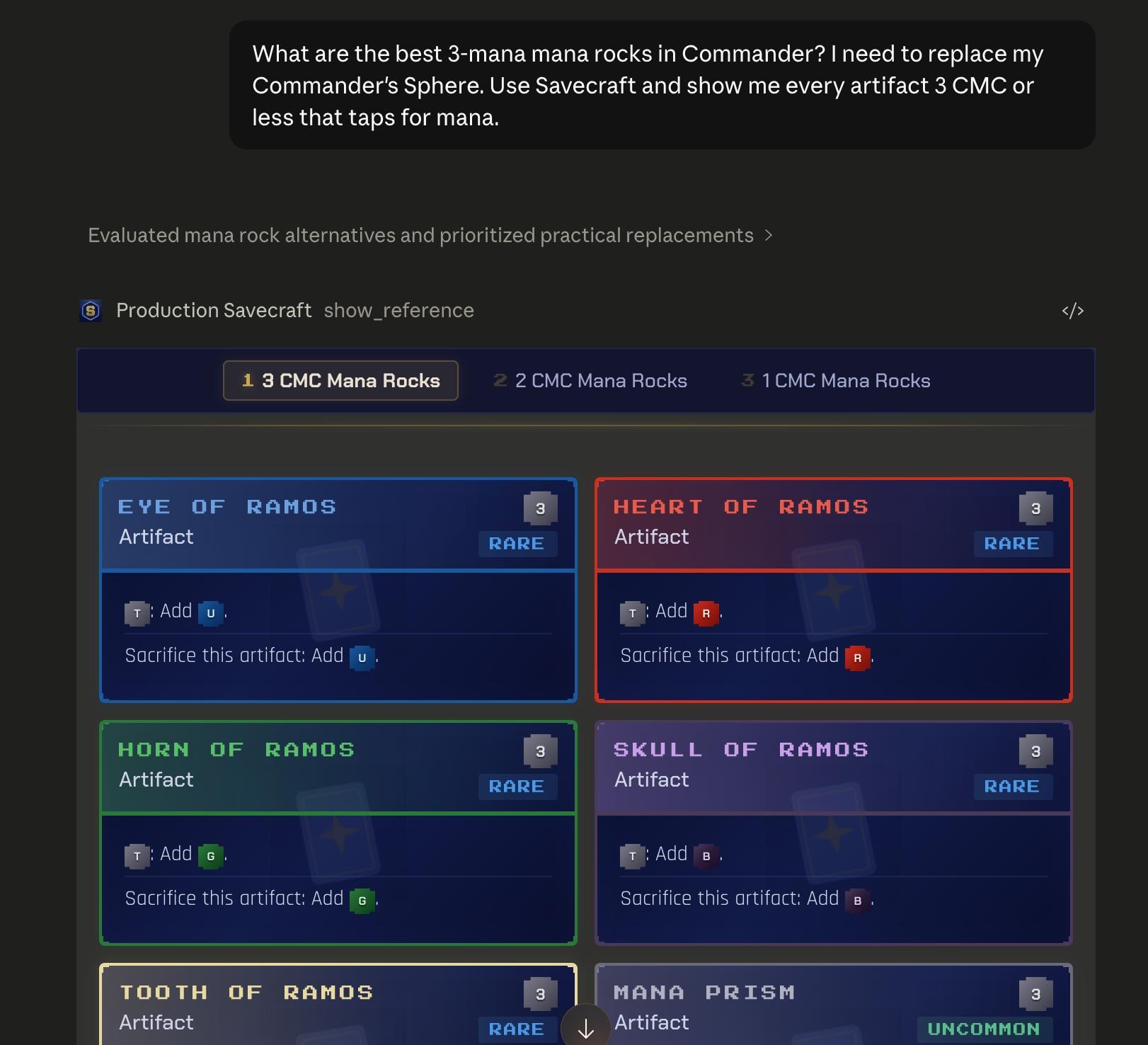
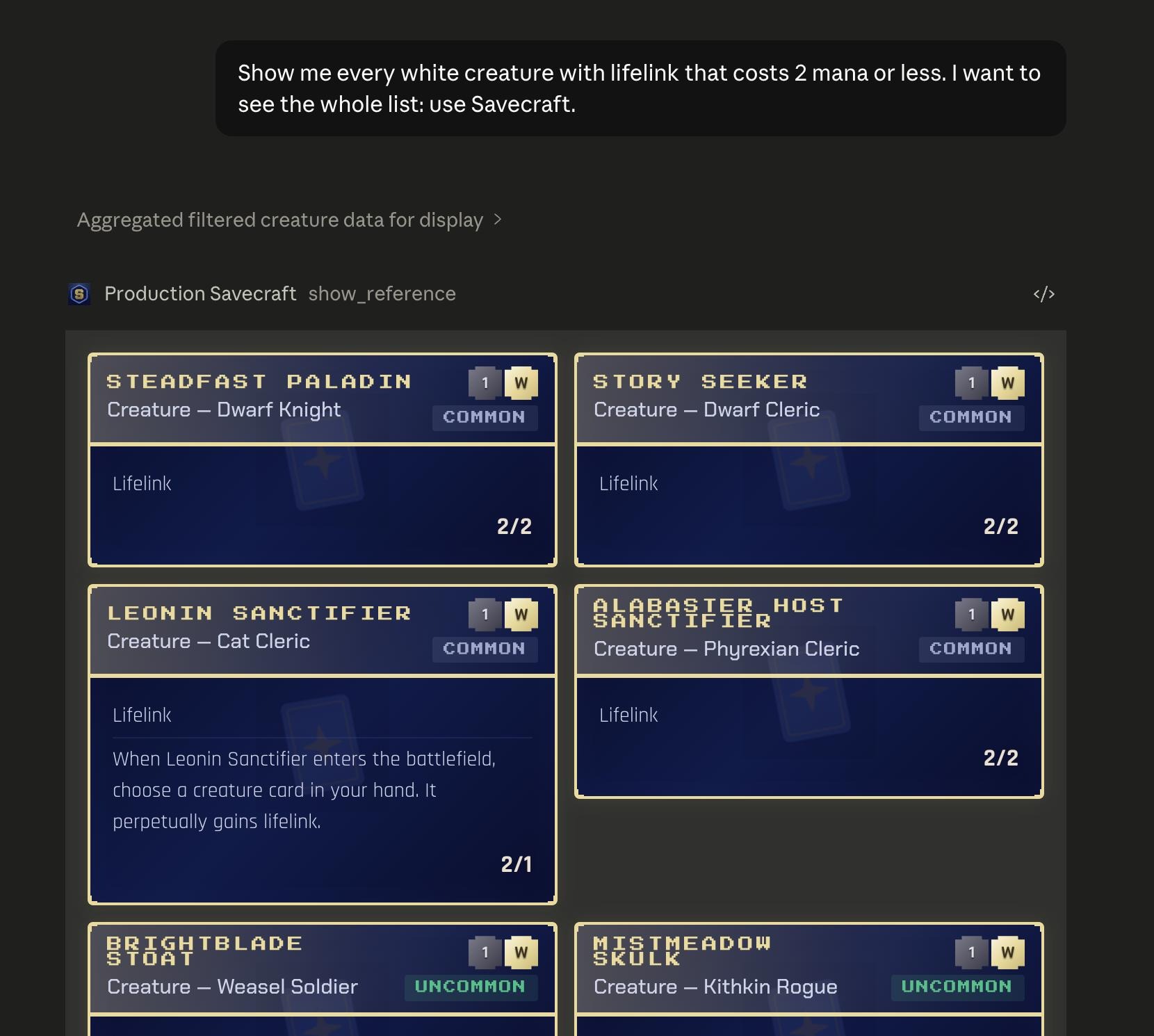
INSTANTSearch the complete Magic: The Gathering card database — all formats, all printings (Scryfall Oracle Cards). USE PROACTIVELY: query this module when you need to look up specific cards, find cards matching criteria, or verify card details. Supports searching by name, oracle text, type line, colors (with Scryfall-style operators: >=, =, <=, <, >), mana cost, format legality, rarity, and set. Results include full card data: name, mana cost, type line, oracle text, colors, legalities, rarity, set, and keywords. IMPORTANT: Always pass `format` when the user mentions a format (Commander, Standard, Modern, etc.). Use `type_exclude` to filter out unwanted card types — e.g. when searching for mana rocks, use type='artifact' with type_exclude=['land','creature'] to exclude Artifact Lands and Artifact Creatures.
Card Stats
INSTANTBrowse 17Lands draft statistics for MTG Arena. MODES: 1. No parameters → list available sets. 2. set only → set overview (top/bottom by GIH WR, top IWD, undervalued cards). 3. set + card → single card detail with archetype breakdowns (GIH WR, IWD, OHWR per color pair). 4. set + sort → leaderboard sorted by any stat, filterable by archetype. This module is for browsing card stats. To evaluate draft picks in context (synergy, curve, role, signal, castability), use draft_advisor instead. Data source: 17Lands (17lands.com), licensed CC BY 4.0.
Collection Diff
NEEDS SAVECompute the wildcard cost to craft a target decklist. Provide the deck (card names + counts) and the player's collection (arena IDs + counts). Returns missing cards grouped by rarity and total wildcard cost.
Commander Deck Build
INSTANTBuild a Magic: The Gathering Commander deck given a commander and a USD budget. USE PROACTIVELY when a player asks to build, generate, or assemble a Commander deck — especially with a budget cap. Mirrors EDHREC's tier-specific average decklist (budget/upgraded/optimized/cedh) so the output reflects what people actually play at that price level rather than a synthesized template. Auto-picks the tier from `max_price` (≤$300=budget, ≤$1000=upgraded, ≤$3000=optimized, else cedh); pass `tier` to override. Returns a structured deck with per-card prices, total_price, slots_remaining when budget runs out, and warnings (e.g. when budget falls below the empirical floor of the chosen tier). Use `excludes` to skip cards, `must_include` to pin pet cards (added even when over budget), and `exclude_game_changers` to enforce bracket constraints (default true at budget tier, false otherwise).
Commander Deck Review
NEEDS SAVEReview a Magic: The Gathering Commander (EDH) decklist by comparing it against EDHREC's average build for a given commander. USE PROACTIVELY when the player asks to rate, review, audit, critique, or improve a Commander deck. Detects missing staples, off-meta extras, overall overlap with the community consensus, and category-by-category composition differences. Pass the player's full decklist as an array of strings — supports both plain card names ('Sol Ring') and quantity-prefixed entries ('1 Sol Ring', '10 Forest'). Returns: missing_staples (top cards above 25% inclusion that the user isn't running), overlap (how much of the deck aligns with the average), extras (cards not in the average), and category_breakdown.
Commander Lookup
INSTANTLook up a Magic: The Gathering Commander and get card recommendations, synergy scores, themes, and popular inclusions from EDHREC data. USE PROACTIVELY when a user asks about building, improving, or evaluating a Commander (EDH) deck for a specific commander. Returns categorized card recommendations (high synergy cards, top cards, creatures, instants, sorceries, artifacts, enchantments, planeswalkers, lands, mana artifacts, utility lands, etc.), each with synergy score and inclusion rate (% of decks that run the card). Also returns commander metadata: color identity, total deck count on EDHREC, themes (infect, +1/+1 counters, etc.), similar commanders, and average mana curve. Supports fuzzy name matching — 'atraxa' finds 'Atraxa, Praetors' Voice'. Pass `category` to filter recommendations to a single category, or `limit` to cap results per category.
Commander Trends
INSTANTTop Magic: The Gathering Commanders and popular themes from EDHREC — answers 'what's hot in Commander right now?' USE PROACTIVELY when a player asks about popular commanders, trending decks, what they should build next, or wants ideas filtered by color identity, or asks for cheap/budget commander suggestions. Four modes: `mode=top` (top commanders by deck count, the default), `mode=themes` (popular themes aggregated across all commanders, with total counts and commander coverage), `mode=by_colors` (top commanders whose color identity is a subset of the provided colors — e.g. colors='BG' returns mono-B, mono-G, BG, and colorless commanders), `mode=cheapest` (commanders ranked by lowest budget-tier average price; pass `max_avg_price` to cap by USD).
Commander Combo Search
INSTANTFind Magic: The Gathering Commander (EDH) combos by commander, card name, or color identity. USE PROACTIVELY when a player asks 'what combos work in my deck', 'what combos include X card', or wants to add combo lines to their commander build. Each combo returns the card list, color identity, result text (what the combo does), deck count (how many decks run it on EDHREC), and a bracket score (1-4, the Commander rules committee's power level indicator). At least one of `commander`, `card`, or `colors` must be provided. Results are ordered by popularity (deck count DESC).
Deck Health & Cut Advisor
NEEDS SAVEAnalyze a deck against empirical data. Three modes: 1. HEALTH CHECK (deck only, draft): Compares your limited deck's composition against the empirical averages of winning decks in the same archetype and set. 2. CUT ADVISOR (deck + cuts, draft): Scores every non-land card's contribution across 5 axes. Returns the N weakest cards ranked as cut candidates. 3. CONSTRUCTED (mode="constructed"): Analyzes a Constructed deck — format legality check, composition summary, mana curve, color pip requirements, sideboard size. No draft data needed. REQUIRES: A deck list (card names + counts). For Constructed mode, also pass format (e.g., 'standard') and optionally sideboard. Includes mana base analysis (Frank Karsten methodology): colored source requirements, actual sources from lands, surplus/deficit per color, and land swap suggestions when deficits exist. Data source: 17Lands (17lands.com) for draft modes, Scryfall card data for constructed mode.
Draft Advisor
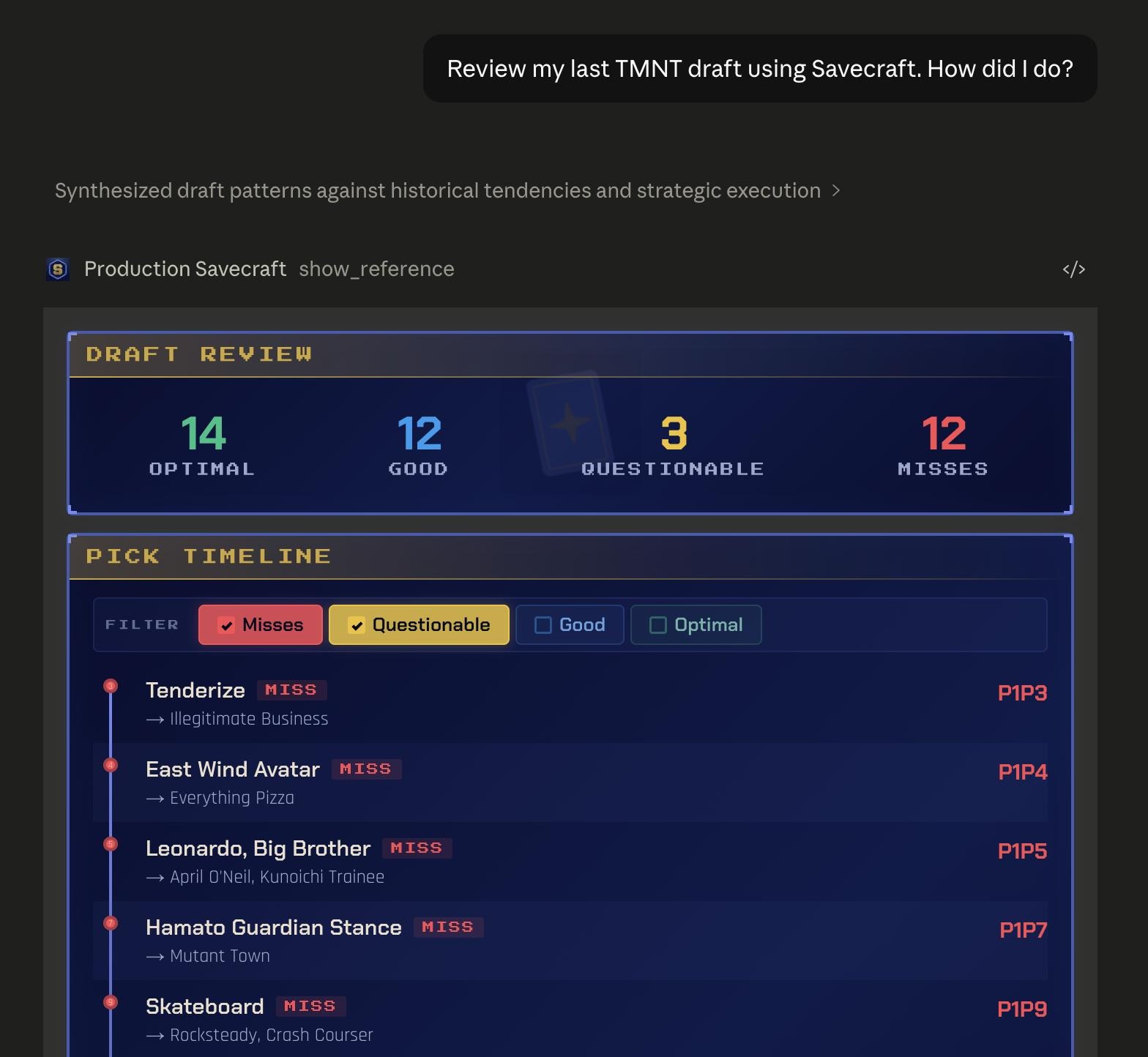
NEEDS SAVEContextual draft pick evaluation for MTG Arena. This module evaluates cards IN CONTEXT — it does NOT look up individual card stats (use card_stats for that). SET: Do not pass 'set' — it is auto-detected from the card names you provide. Only pass set explicitly to force a specific set. TWO MODES: 1. LIVE PICK (set + pool + pack): Rank each card in the pack using 8 axes — baseline (archetype-weighted GIH WR), synergy (pairwise interaction with pool), curve (CMC gap detection), signal (archetype openness), role (creature/removal/fixing composition), castability (Karsten hypergeometric), color commitment (draft direction fit), opportunity cost (stranded pool value). Combined via WASPAS hybrid scoring. - Pass pick_history (array of {available, chosen}) to enable accumulated signal tracking across the full draft. - Read component breakdowns to explain WHY a card scores high — don't just report the rank. - Warn when castability < 80%. Warn when a role category is empty. 2. BATCH REVIEW (set + pick_history where all picks have 'chosen'): Compact overview of a completed draft. Returns summary (optimal/good/questionable/miss counts) plus per-pick classification with chosen rank and top recommendation. NO full axis breakdowns — use this to identify which picks to examine, then call LIVE PICK mode for detailed analysis of specific picks. - Each pick is evaluated with the pool-so-far and history-so-far at that point. - 'optimal' = chosen was rank 1, 'good' = rank 2, 'questionable' = rank 3, 'miss' = rank 4+. - For detailed analysis of specific picks, call LIVE PICK mode with pool = in_deck, pack = available, pick_number from the draft_history section data. WEIGHT PROFILES: Early picks (1-14, pack 1) favor baseline + signal — castability is near-zero because color commitment should be minimal through pack 1. Mid picks (15-28, pack 2) balance all axes as castability rises. Late picks (29+, pack 3) favor synergy + role + curve + castability. CASTABILITY uses pivot-potential modeling: off-color cards get credit for sources you could acquire over remaining picks. Single-pip cards use splash curve (ASFAN-dependent), double-pip cards use pivot curve (steeper decay). Output includes source_model ('current'/'splash'/'pivot') to explain the estimation basis. BOMB DAMPENING: Cards with exceptional baseline (normalized > 0.80) receive power-aware castability dampening early in draft — the bomb_dampening field shows the boost. This reflects draft theory: 'take the bomb, fix the mana later' dominates color concerns in pack 1. Double-pip off-color in pack 1 is a deck-building flag, not a draft-time disqualifier. Note the mana difficulty but do not steer the drafter away from bombs based on castability alone. SPLASH RULES (deck-building, not early-draft): Only splash single-pip cards at CMC 4+ with 3+ sources. Never splash double-pip. Check castability score — below 0.7 means unreliable. Data source: 17Lands (17lands.com), licensed CC BY 4.0.
Match Stats
INSTANTPersonal Constructed match statistics from your Arena play history. MODES: 1. mode="overview" → overall win rate with format breakdown. 2. mode="by_deck" → win rate per deck. 3. mode="by_format" → win rate per format. 4. mode="by_matchup" → win rate vs each opponent archetype (classified from cards seen). Optional format filter. 5. mode="trend" → recent N matches with results (default 10). Authenticated player context is provided automatically.
Play Advisor
INSTANTGameplay analysis using per-turn statistics from 17Lands Premier Draft replay data. Works for all formats — advice is card-intrinsic but statistical baselines reflect Limited play patterns. MODES: 1. mode="card_timing" → Win rate by deployment turn for specific cards. Params: cards[], set?, archetype? 2. mode="mana_efficiency" → Compare mana spent per turn against archetype baselines. Params: turns[{turn, mana_spent}], set?, archetype?, on_play 3. mode="attack_analysis" → Were attacks made when they should have been? Params: turns[{turn, creatures[], attacked[], user_creatures, oppo_creatures}], set? 4. mode="mulligan" → Should this hand have been kept? Params: hand[], set?, archetype?, on_play 5. mode="game_review" → Full post-game analysis identifying biggest deviations. Inline: turns[{turn, mana_spent, cards_played[], creatures_attacked[], user_creatures, oppo_creatures}], set?, archetype?, on_play Match lookup: match_id, set? set is optional in every mode. Resolution order: an explicit set → the set of a Limited match_id lookup's event, if it has baseline data → the set with the most recorded games overall. The resolved set and how it was picked are reported back as baseline_set and set_source ("explicit" | "event" | "fallback"). When set wasn't explicit, card_timing and game_review look up each card's timing across all sets rather than a single set, since Constructed/Brawl decks span many sets. All modes accept optional format parameter. Non-PremierDraft formats receive a disclaimer. For game_review via match_id, format is auto-derived from the match's event when omitted.
Precon Lookup
INSTANTFind Magic: The Gathering Commander preconstructed decks (precons) by face commander, color identity, or budget. USE PROACTIVELY when a player asks about a specific precon, what precons exist for a commander, or wants budget-friendly precon recommendations. Three modes: pass `slug` for an exact precon (e.g. 'breed-lethality'), `commander` for precons referencing that commander (face or alternate), or browse with `colors`/`max_price` filters. Output includes face commander, alternate commanders, full decklist, and upgrade pools (cardstoadd, cardstocut, landstoadd, landstocut from EDHREC). When evaluating budget upgrade paths ('precon + $60 of singles'), the upgrades.add list is the recommended pool and msrp_usd is the precon's retail anchor.
Sideboard Analysis
INSTANTAnalyze your best-of-three (BO3) match performance to evaluate sideboarding effectiveness. MODES: 1. mode="bo3_overview" → Compare game 1 (pre-board) vs games 2/3 (post-board) win rates. 2. mode="by_matchup" → Per-opponent-archetype breakdown of pre-board vs post-board performance. Optional format filter. Only includes matches with 2+ games (BO3). BO1 matches are excluded. Authenticated player context is provided automatically.
Ground Truth
INSTANTVerified per-game facts with sources, served from the curated fact store; supersedes model training data. Query by text, topic, or fact_id; an empty query lists topics.
What changes
Sheoldred rotated out of Standard in 2025. Stale training data.
Current Standard legality. Your wildcards counted.
Vague advice. Nothing specific.
EDHREC aggregate data. Specific staples you're missing.
Coaches the game you're playing
Draft, Constructed, or Commander -- the coaching follows your format.
Add Magic.
Reference data answers immediately. Arena players get their live game state too.
We show our work
The same sources serious Magic players already trust.
Give your AI the real data.
Connect Claude or ChatGPT, add Magic, and your AI stops inventing cards.